
Off Kilter is written by Paul Worthington, President of Invencion. Once described as the “antidote to groupthink,” he advises CEOs, boards, and senior marketing leaders on strategy, brand, and customer value creation. Especially when your problems are messy, the future uncertain, and the LLM answer a little too obvious.
If you’d like to talk, just hit reply.
Zoe Scaman recently wrote a thought-provoking piece arguing, broadly, that today’s LLMs are being trained to be right rather than original, and that creative businesses therefore need their own models designed to produce more divergent thinking. It’s interesting; you should read it.
However, as I read it, I found myself thinking less about creative production and more about its distribution. While a more creatively optimized LLM might help marketers produce stranger, more original work, that work still has to enter a dominant media environment optimized for converged expression.
Which made me wonder whether the more interesting creative opportunity for AI isn’t generating more creative output at all, but redesigning the cultural distribution systems through which creativity is discovered, rewarded, and scaled.
The shape of opportunity.
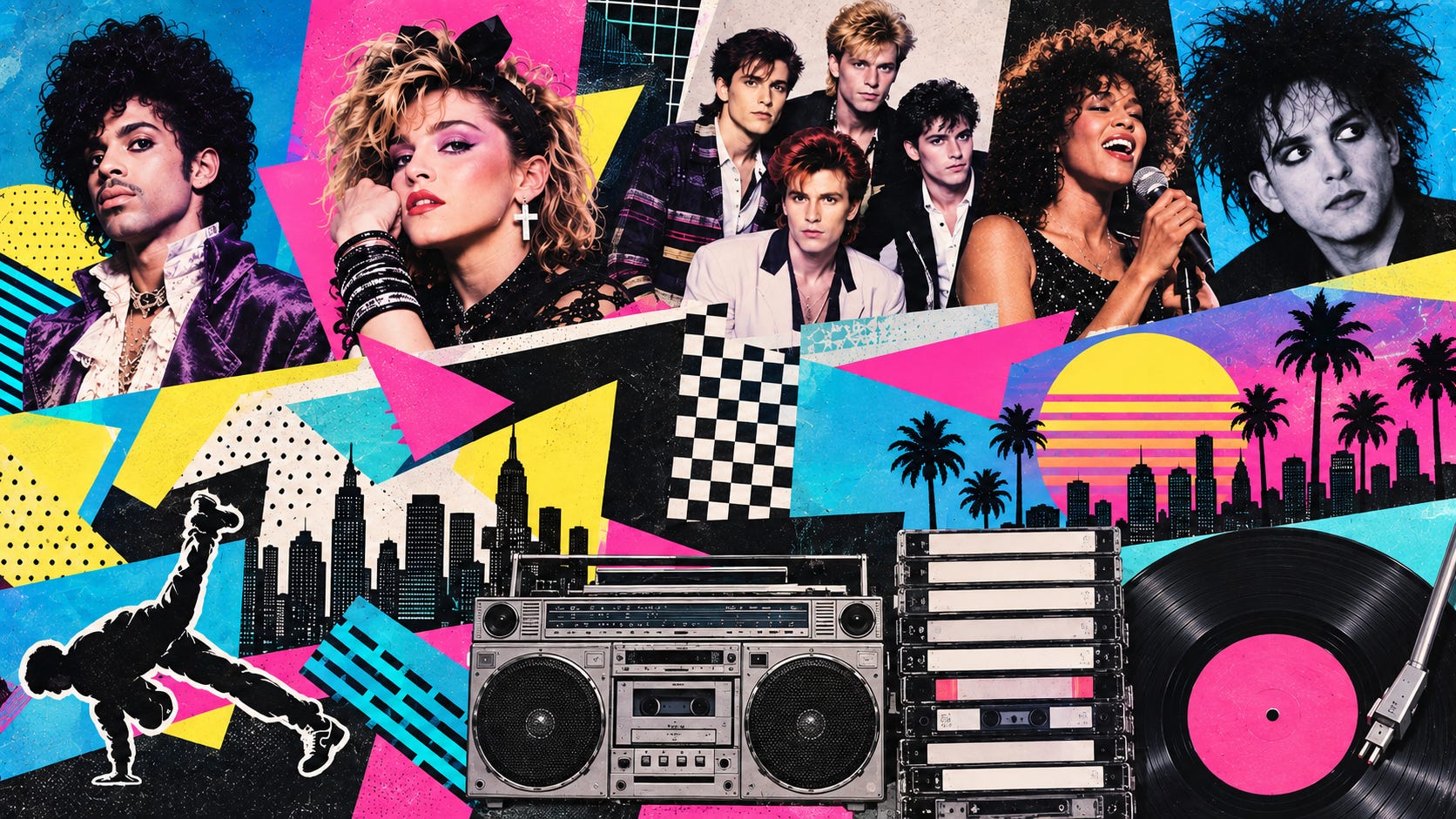
Let’s use music as a proxy. Between 1980 and 1986, a remarkable number of genuinely different musical forms migrated from the cultural edges to mainstream adoption. Among these, hip-hop, electro, new romanticism, hardcore, thrash metal, and house music weren’t simply variations on established genres; they brought different sounds, aesthetics, tribes, and ideas about what music could be.
Now, let’s compare this to the period from 2020 to 2026…crickets…waiting…brrrr…bloop…processing…um…still waiting…grrr…nope.
This isn’t because today’s cultural edges are somehow less creative. We’ve massively democratized cultural creation and distribution, which produces more scenes, subcultures, microgenres, aesthetics, and assorted weird shit than before. What changed is the edges' capacity to influence society more broadly.
This is because we democratized production and distribution, but not the commercial mechanisms that migrate culture from the edge toward the center. Instead, we outsourced these mechanisms to a tiny number of extraordinarily efficient algorithms optimized for engagement, retention, and commercial exploitation.
The result is a curious paradox. Culture appears to be fragmenting and experimenting faster than ever at the edges while becoming increasingly stagnant at the center. What looks like cultural velocity disguises a curious lack of progress. We’re not standing still exactly; we’re frantically spinning in place. And if early evidence is to be believed, generative AI is about to accelerate this stagnation at the speed of a slop cannon.
But this doesn’t have to be.
What if AI, as probabilistic software programmed through natural language, allowed us to build systems designed to seek uncertainty rather than eliminate it; to surface distant adjacencies, anomalies, and things that may sit well outside of what platforms already know we like?
As AI radically reduces the cost of sophisticated software, this concept shifts from philosophical musing to something buildable. Not another personalized feed optimized to exploit our attention ever more precisely, but something almost the opposite: a computational system that feeds our curiosity with genuinely different things worth exploring.
1. Pluralistic elitism.
The old media world was hardly a bastion of democratized access. A&Rs, editors, gallery owners, commissioners, studio executives, etc., all had enormous power to decide what the rest of us heard, saw, and experienced. They were often elitist, exclusionary, and spectacularly wrong.
But if we zoom out, it’s clear that they were often wrong in different ways. Yes, at the micro level, cultural amplification was concentrated in the hands of elitist tastemakers, yet at the macro level, these tastemakers competed with each other for success.
They weren’t optimizing against the same behavioral dataset. They were making bets against each other, where winning often required contrarian predictions about where culture was going, rather than where it already was. The resulting system may have been inefficient and riddled with cracks, but those cracks were precisely the pathways through which cultural divergences could escape the edges and scale.
The lesson, as we consider the future, isn’t a shitstalgic return to the cigar-chomping A&R guy telling you your band won’t make it. What we lost wasn’t elite judgment; it was the pluralism of ideas that elite tastemakers competing with each other for supremacy enabled.
2. Algorithmic orthodoxy.
Today’s cultural gatekeepers are also competitive, but they’re competing on a completely different playing field. TikTok, Instagram, YouTube, Spotify, LinkedIn, and all the rest want our attention. And while their algorithms may differ, their objective is highly aligned: identify what will engage us for longer, and serve us more of it.
Once these systems began gating culture, they trained people how to behave. No TikTok memo explained that success in food influencing requires enormous portions, gratuitous cheese pulls, and a tight head shot of a grease-laden chin, rolled-back eyes, and orgasmic moans. We just need to see it work enough times to copy it.
Creators copy what succeeds, newsletters codify the patterns, and training courses teach them to others. Eventually choices become rules, and the platform’s statistical preferences dictate the bounds within which cultural creativity must be presented.
Sociologists call such convergence isomorphism. People copy what appears to work, institutions formalize accepted practice, and organizations respond to similar incentives. Our digital environment adds two powerful new layers: algorithmic isomorphism, where machines systematically reward patterns resembling prior winners, and generative isomorphism, where AI learns from what’s now in its training data and makes these patterns cheaper, easier, and faster to reproduce.
The lesson here isn’t that we’ve run out of creative people or creative output. Quite the opposite. It’s that we’ve built incentive systems in which wildly different cultural content increasingly has to conform to the exact same presentation formulas to be seen. This means we can’t just exhort people to be original; we need incentive structures in which creative divergence has a viable path to reward.
3. Mistaking speed for movement.
Modern culture feels exhaustingly fast because it is, but only at the edges. Microtrends appear and disappear, memes mutate, aesthetic labels multiply, genres subdivide, and democratized production continuously creates strange new cultural fragments. The problem is that remarkably little of this energy influences culture more broadly.
This is because the algorithmic grammar of the platforms barely changes even as the content passing through it does. Music produces endless microgenres, yet genuinely new forms rarely jump from edge to mainstream. Hollywood releases tidal waves of seemingly new entertainment atop decades-old IP. Social platforms expose us to extraordinary diversity of subject matter, yet the form and presentation is startlingly repetitive. What’s happening is that the edges are proliferating with ideas, while the pathways toward broader cultural influence stagnate under convergence.
Distinguishing between cultural exploration and commercial exploitation helps explain why. Healthy cultural-commercial systems need a continuous cycle of both. Exploration creates the strange, anomalous, unknown things nobody quite knows what to do with yet. Commercial exploitation takes what emerges, shaves off some of the edges, and scales it for broader audiences. Then the process starts over again. The problem isn’t commercial exploitation itself; it’s that our exploitation systems have become so extraordinarily efficient at extending proven forms they’re crowding out exploration as a viable pathway to success.
This is where dropping generative AI into the existing system risks metastasizing the problem. Train models on a corpus already shaped by isomorphic selection, then use those models to manufacture endlessly competent variations of patterns already known to scale, and we dramatically increase the stagnation of our cultural environment.
This stagnation may also help explain the growing nostalgia among younger people for what appears to be a culturally richer time, as they seek more offline and analog experiences they’ve never had before. What’s interesting isn’t that the past feels more attractive; it’s that the contemporary mainstream feels so over-optimized.
The lesson isn’t that exploration has disappeared. It’s clearly flourishing. The problem is that too much of it dies before it has a chance to become culturally consequential, and what lives does so because it conforms to algorithmically rewarded patterns.
The lesson is that we need systems that protect the strange, uncertain, and unproven long enough to let them emerge and scale.
4. A more pluralistic culture?
So, what might we actually build if we took these three lessons seriously?
First, we need to restore cultural pluralism. The old system was bottlenecked by a small number of tastemakers, while the current system is bottlenecked by algorithmic convergence. While dropping AI into existing systems risks metastasizing stagnation, using AI to redesign the systems themselves gives us a chance to remove, or at least reshape, both bottlenecks by combining computational scale with multiple competing theories of taste.
Traditional ranking systems primarily infer taste from behavioral signals and optimize against relatively fixed objectives. By contrast, modern AI models can increasingly match patterns across sound, image, language, context, relationships, and meaning, allowing different curatorial systems to embody genuinely different ideas about what’s interesting rather than different ways of scaling what’s already popular.
This is because AI lets us run many competing curatorial logics. One might seek out what’s aesthetically distant from the mainstream. Another might look for small but unusually interesting cultural scenes. Another could search for genuinely discontinuous ideas that don’t fit existing categories at all. Human curators could even encode their own theories of taste, extending a distinctive point of view far beyond what any one person could personally sift through.
And while we could argue about any algorithm’s capacity to surface genuine taste, that doesn’t change the fact that AI now creates the opportunity to automate pluralism.
That doesn’t mean asking AI to invent fifty arbitrary opinions for the sake of it. It does mean using probabilistic software to make different forms of judgment economically viable at scale.
Second, we need to reward divergence.
This is harder than simply rewarding difference. Spotify could massively increase the diversity of what we listen to by randomly inserting Bulgarian folk music and German beer-drinking songs into our playlists, but that would be terrible. (Fun fact: I own a vinyl box set of German beer-drinking songs. I bought it for $1, for a laugh. I even listened to it once, while drinking pilsner.)
The opportunity isn’t randomness, but meaningful distance: things far enough beyond what we already know to expand our aperture, yet connected enough to give us a plausible way in. Instead of “people who liked X also liked Y,” AI can potentially identify an unexpected connection in aesthetic, rhythm, attitude, technique, or worldview between something unfamiliar and something we already value.
This opens up a different kind of personalization. Today’s systems increasingly learn what we like. An exploratory system could learn how far beyond what we like we enjoy exploring.
If this were possible, it would change how platform incentives work. If platforms could identify what meaningfully departs from established patterns, rather than simply rewarding what already drives engagement, then originality would no longer have to survive in spite of the algorithm. Creative divergence would become something the system is explicitly designed to surface, reward, and potentially scale.
Third, we need to protect exploration.
Something genuinely new almost always has a measurement problem. Too few listeners, too small an audience, too little engagement, no established category, and therefore no meaningful benchmark against which to prove itself. By the time traditional metrics can confidently tell us something matters, the most interesting exploratory ideas may already be buried.
AI can potentially help us identify coherent signals before they scale.
A small music scene might contain a cluster of artists borrowing from each other in unusual ways. A visual language might be developing across a handful of accounts. A tiny audience might exhibit unusually deep engagement around something almost nobody else understands. Today, our commercial exploitation metrics mostly treat this as irrelevant, but a multimodal AI system can at least potentially see where distinctive and interesting patterns are beginning to form.
A platform might then deliberately reserve part of our feeds for things it has less confidence we’ll like, simply because that uncertainty creates room for discovery. This could protect small but coherent cultural communities from being immediately judged against mainstream engagement benchmarks, allowing strange new cultural forms enough time and attention to reveal their potential for influence.
Bring the three together, and we’re left with a very different idea of what a media platform could be. Not a single ranking logic, but many. Not optimization exclusively around demonstrated preference, but incentives for meaningful divergence. Not instant judgment by scale metrics, but protected space in which exploration and organic emergence can develop before exploitation takes over.
And maybe this is the most interesting creative opportunity for AI. We already have more creativity and cultural production than anyone could consume in several lifetimes, so perhaps we don’t need a slop cannon firing more of it at us. The edges are already rich, diverse, and weird. What we lack are the pathways for more of us to access them.
What we need are systems that help us explore, discover, and experience what’s being created far more pluralistically; systems that use what they know about us not to endlessly narrow the world around our demonstrated preferences, but to expand the boundaries of our tastes and sense of possibility. And, in doing so, loosen the algorithmic stagnation that currently determines the boundary conditions of creativity.
Get this right, and perhaps a far richer and more diverse version of culture finds us, instead of us having to find it by wading through the weight of algorithmic inertia.
Now, do I think such a platform concept would succeed? Dunno. I’d like to think we’ll see lots of ideas duking it out as the cost of software creation collapses, but VCs don’t call competing against behemoths a killing zone for nothing. However, if those behemoths are as boring, stultifyingly formulaic, and commercially exploitative as they’ve become, then maybe someone should give it a go? After all, at the start of the last technological paradigm shift, Facebook was given little chance against Friendster and Myspace. Turns out that was wrong.
Or, to invert Timothy Leary, we could just turn off, tune out, and drop in to our analogue communities and let serendipity do its work. Any algorithmic solution would, by its nature, be anti-creative, no? Culture is not, and should not, be defined by its commercial potential. Not all culture needs to break through to the mainstream. Mainstream culture is just that, mainstream. If it’s defined by slop and conformity, then so be it. Culture at the edge dies when it’s packaged, commercialised, and commoditised. Counter-culture will survive and thrive. Not all cultural movements are looking for a price tag.
Love this Paul - protecting exploration is bang on. Creativity can not be boiled down to a formula, and if all marketing heads that way using a raft of AI agents nothing will feel genuinly unique, no one will take risks, outlying individual brilliance wont cut through and campaigns will lack memorability. For the majority of big brands, are we not unfortunatly already there?...