
Off Kilter is written by Paul Worthington, President of Invencion. Once described as the “antidote to groupthink,” he advises CEOs, boards, and senior marketing leaders on strategy, brand, and customer value creation. Especially when your problems are messy, the future uncertain, and the LLM answer a little too obvious.
If you’d like to talk, just hit reply.
We’ve lost sight of marketing’s purpose.
Go to any marketing conference anywhere in the world right now, and you’d be forgiven for thinking everything was ambrosia and strawberries because either AI will do it or human creativity will.
Back in the real world, budgets are under pressure, demands are up, and marketing’s position in the C-suite is deteriorating. According to Forrester’s 2026 analysis of the Fortune 500, just 52% of companies have a senior marketing executive on their executive team or reporting directly to the CEO, a cliff dive from 63% two years earlier.
Meanwhile, we’re witnessing a proliferation of Chief Growth Officers, Chief Commercial Officers, Chief Customer Officers, and countless other attempts to reorganize the responsibilities traditionally associated with marketing.
Something serious is happening, and it has more than a whiff of desperation.
While not the sole reason, much of this is self-inflicted, as we’ve steadily conflated the purpose of marketing with the efficient delivery of marketing activity. Meanwhile, marketers throw the word growth around with abandon, without clarifying what we’re supposed to be growing. Is it impressions? Engagement? Response rates? Marketshare? Unit volume? Revenue? Brand equity? Customer numbers? Profit?
None of which are the same as growing the worth of the company, which is ultimately what the C-suite and investors care about. Two trends, in particular, have been especially destructive in disconnecting marketers from the conversation about the economic value of the corporation:
Elevating ROI from a useful measure of investment efficiency to the governing objective of marketing has made us increasingly preoccupied with optimizing measurable returns from individual marketing activities.
Allowing a dangerously narrow conception of marketing science to acquire disproportionate strategic authority. In a 2024 paper, Byron Sharp and his Ehrenberg-Bass colleagues proposed the central question of marketing science be why some brands sell more than their competitors. A legitimate academic question that’s far too narrow to guide practitioners in the business of creating and capturing value.
Together, these reinforce an increasingly narrow conception of marketing as a collection of activities designed to capture existing demand as efficiently as possible, governed by science-backed theories that largely ignore the most economically valuable forms of growth.
Unless we address this misunderstanding, renaming marketing as growth, commercial, customer, or the Office of Purple Pants won't solve, well, anything.
Perfectly optimizing a vicious cycle.
The fundamental problem is that optimizing the individual nodes in a system doesn't necessarily improve overall system performance. In fact, it can make the system worse.
Today, a typical marketing organization is a system made up of specialist nodes, each instructed to optimize itself for maximum efficiency. Thus, CRM optimizes customer relationships. Performance marketing optimizes conversions. Media optimizes audience delivery. Email optimizes engagement. Each has its own metrics, targets, externally defined benchmarks, and, increasingly, AI-driven agents and automations creating havoc.
Yet, because we’re optimizing each node independently, we’ve developed a poor understanding of the overall system that emerges from their interactions. This means we might attribute the same sale to several different activities, each claiming responsibility for its own success. Or we might reduce the cost of one activity while increasing costs elsewhere. Or, we may improve a short-term metric while undermining a relationship or capability on which future performance depends.
And because our preferred measures of business impact require demonstrable returns in the current period, activities whose contributions are less immediate or more uncertain become difficult or impossible to justify.
Consider a business that cuts investment in customer understanding because it cannot demonstrate immediate ROI. Over time, its products become less relevant, demand becomes harder to generate, and it requires greater advertising spend to maintain sales. As acquisition costs rise, pressure to improve marketing efficiency increases, further constraining investment in understanding customers, further limiting the future possibilities and strategic options available to the corporation.
Every decision might make sense against the individual metric being optimized, yet the business as a whole becomes progressively less capable. The problem isn't simply that these activities are interconnected; it's that they’re interdependent. As value flows through and across their connections, each decision can strengthen or diminish the system's capacity to create present and future value for customers and the corporation.
Two forms of value. One interconnected system.
Managing marketing for economic growth means managing the flow of value through the system, not simply maximizing the independently measured efficiency of its constituent parts.
Marketing is the business discipline of future customer value creation and subsequent value capture. Not advertising, demand generation, communications, or any particular collection of executional activities. Nor is it limited to a department, or an argument that everything should ladder up to a CMO. Instead, it’s the business discipline concerned with understanding what people value, determining how a business can create that value, and connecting the resulting customer experiences to the corporation’s economic performance.
To understand this, we must recognize two fundamentally different forms of value: value to the customer and value to the corporation.
Value to the customer.
Customer value exists as utility: something that makes life better, easier, more enjoyable, more meaningful, or expands what someone can do or become. This utility might be functional, emotional, experiential, social, symbolic, cultural, or some combination. And the forms of value that matter to one person aren’t necessarily the same as those that matter to another.
It’s too big a subject to cover here, so we’ll explore it in more detail in the next edition focused on The Science of Customer Value.
Value to the corporation.
Unlike customer value, corporate value is expressed in economic terms. Put simply, a corporation must make enough money to sustain itself, fund future activities, and generate returns for its investors. However, what the corporation is worth isn’t defined solely by the money it earns today; it’s determined by investor expectations and beliefs about the money it will earn in the future. In finance lingo, a business’s value reflects the present value of expected future cash flows, accounting for their timing and risk.
Which brings us to the relationship between these two forms of value: Customer value creates the potential for economic opportunity. Any resulting corporate value depends on how effectively we capture that opportunity, now and in the future.
Between these two sentences lies a continuous flow of value from the corporation to the customer and back again. A business invests in capabilities that enable it to create utility for customers. Customers experience that utility, which influences their willingness to buy, pay, return, recommend, or participate. Through these exchanges, the corporation captures economic value. The business can then reinvest some of its returns in the capabilities required to create additional customer value, while learning from its experiences and adapting to changing circumstances.
Net, net, value doesn't appear as if by magic. It must be both created and captured. And the way value flows through the system determines whether that system becomes regenerative or dilutive.
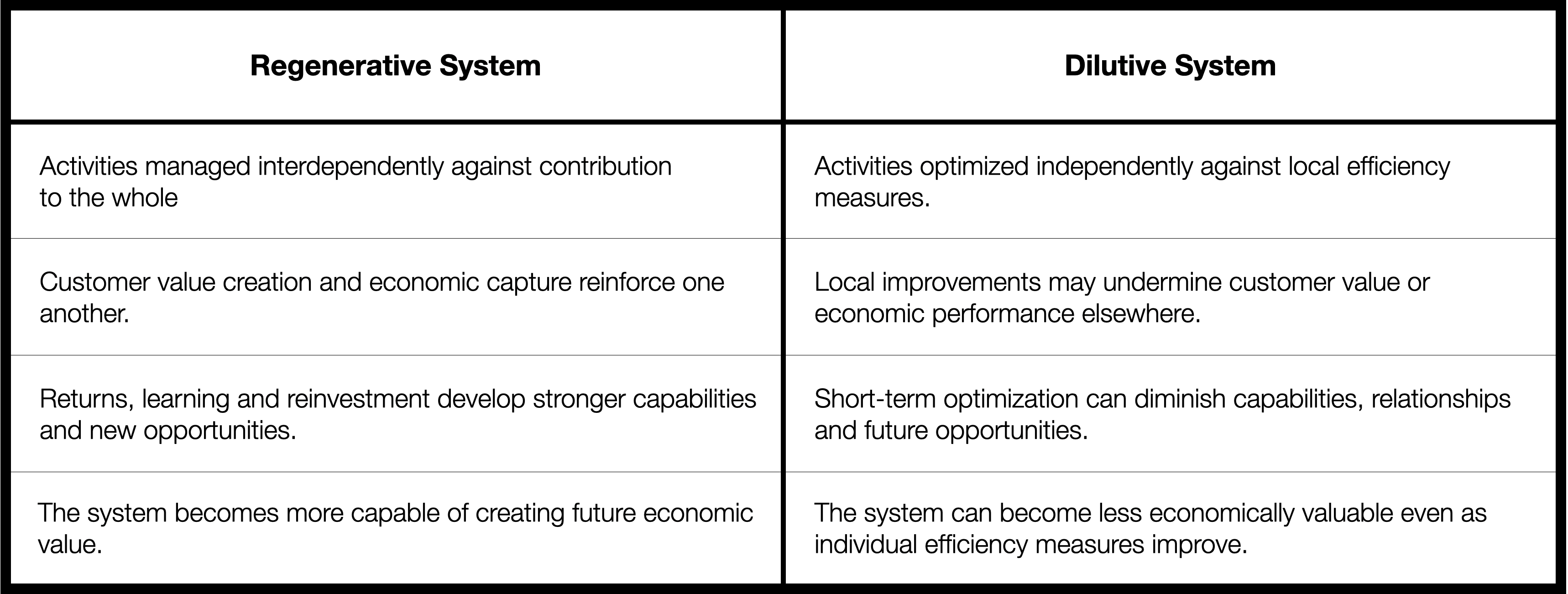
While improving the efficiency of an individual activity may be valuable, when we optimize for localized efficiency without understanding its effect on the flow of value through the whole system, we risk making the system worse, not better. A decision that improves this quarter’s margins might undermine future customer relationships, while an investment that generates no immediate revenue might open tomorrow’s economic opportunities. And something that appears inefficient in isolation may be essential to creating an experience customers will pay more for.
Thus, the contribution of any individual activity depends, often to a considerable extent, on what it enables, strengthens, or diminishes elsewhere in the system.
Different understandings of value create different businesses.
The logic of value creation may be universal, but the business systems through which value flows will not be, rendering the pursuit of a universal marketing model foolish.
How a business understands customer value determines the business systems it builds. These systems, in turn, determine the kinds of value it creates and captures.
Consider a consumer-packaged goods company selling household essentials and a pharmaceutical company developing new breakthrough drugs. While they may both operate through the same underlying logic of customer value creation and economic capture, the business systems they establish will, by necessity, differ.
If we were to slap the same marketing model over both, with the same capabilities, activities, efficiency metrics, and externally defined benchmarks, it's likely both would excel at optimizing for efficiency of spend, and unlikely that either would create the greatest economic value available to it.
The same principle often applies within industries, where competitors may have very different understandings of what customers value, leading them to build different combinations of capabilities and activities.
This is why universal models of marketing excellence are a fool's errand. Standardized marketing activities are easier to benchmark and optimize for efficiency. But economic growth depends on developing the specific system of activities, capabilities, and relationships through which customer and corporate value can continually be created, exchanged, and renewed. And it is this, not efficiency benchmarks, that enables the corporation to increase its worth to investors over time.
Which brings us neatly back to the question of growth.
Not all growth is created equal.
Once we understand the regenerative flow of value between customer and corporation, treating growth as synonymous solely with individual metric uplifts or increased sales starts to look foolish, especially since an additional dollar of revenue isn’t necessarily worth the same as another dollar, even within the same business.
What a company is worth largely depends on shareholders' expectations about the future, not what’s happening in today’s period.
Let’s use Apple to illustrate. Between fiscal 2018 and 2020, Apple’s annual revenue increased from approximately $266 billion to $275 billion, barely 3%. Yet beneath this modest growth, its business economics were changing considerably. Recurring services revenue rose from around $40 billion to $54 billion, growing from 15% to nearly 20% of the total. More importantly, Apple’s financial filings showed services generating gross margins of 66% in 2020, compared with 31.5% for products.
By building a growing services business around its installed base, Apple expanded the value it created for customers while changing the financial characteristics of what it captured in return. Over roughly the same period, its market capitalization doubled from $1 trillion to $2 trillion. We cannot isolate services' contribution to that valuation increase, but Apple's evolving business illustrates how changes in revenue composition, margins, and future earnings potential often matter far more to how investors value the company compared to sales growth alone.
McKinsey has also studied this and makes a particularly stark distinction. In a 2004 analysis, it modeled the shareholder value created by different kinds of organic growth in consumer packaged goods. For every additional dollar of revenue, its model estimated:
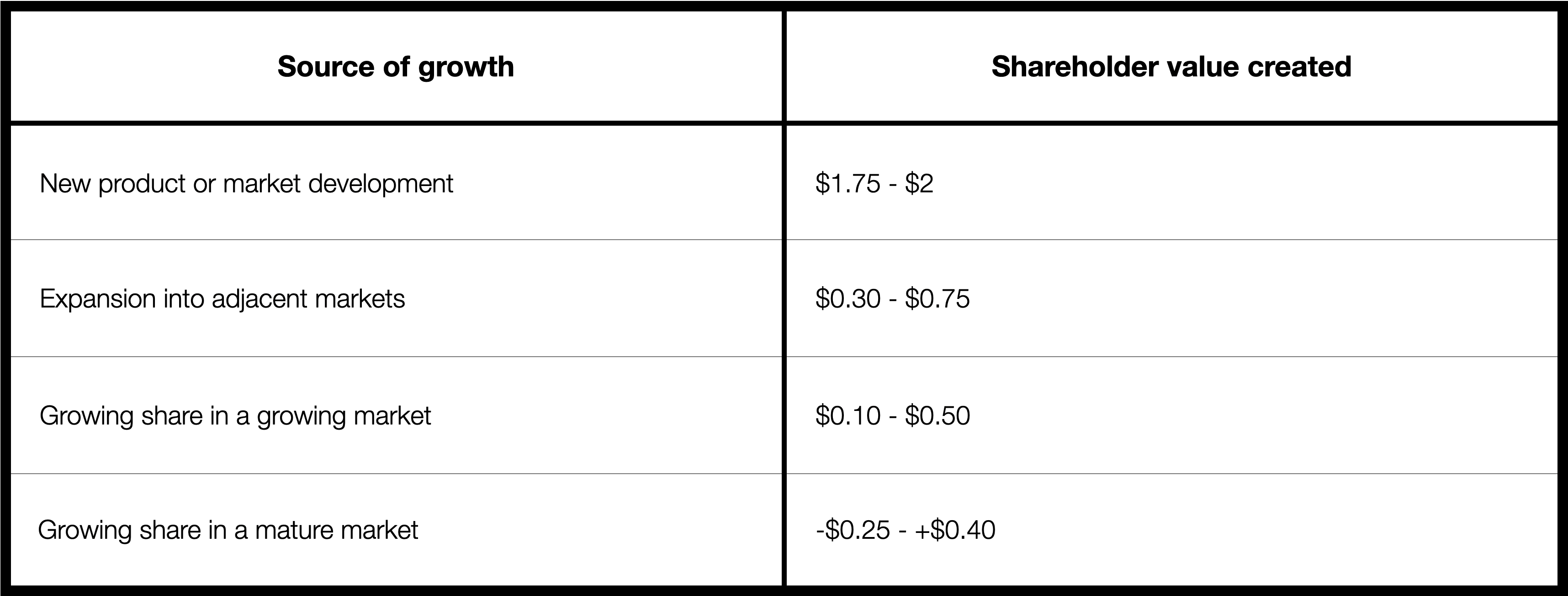
Now, clearly these aren’t universal empirical averages, and the hierarchy will differ across businesses and industries, but they illustrate an extremely important principle: Two separate businesses might achieve identical revenue growth that results in a radically different impact on the corporation's worth to shareholders.
Other research supports the broader distinction. A 2004 Journal of Marketing study of the automobile industry found that both new product introductions and sales promotions increased sales, but their long-term economic consequences differed substantially. New product introductions improved longer-term financial performance and firm value; promotions did not produce comparably enduring gains.
This means the mechanism of growth largely determines how much economic value it creates for the corporation’s shareholders.
This brings us back to Prof. Sharp’s proposed question for marketing science: why some brands sell more than others. Sure, knowing how to gain share may be useful, but it tells us very little about whether capturing that additional demand is the most economically valuable thing a business can do. Indeed, both McKinsey's modeling and the auto study show that winning additional share may create no enduring gain, or even destroy shareholder value.
I’ve already explored the limitations of Ehrenberg-Bass as a strategic guide in The Availability Trap, so I won’t relitigate them here. But I find it remarkable that a body of marketing science whose proposed central question concerns relative brand sales has gained such influence over a business discipline responsible for the creation of value.
Which neatly brings us to the limitations of measuring marketing’s impact through the lens of an efficiency ratio.
The hellscape that is ROI.
When we judge marketing principally through the ROI of its individual activities, we’re measuring the efficiency of the nodes rather than the economic value of the system they create.
This is a more fundamental problem than the familiar observation that maximizing a percentage return doesn’t necessarily maximize total economic value, although that is also true.
ROI is useful when comparing established activities with similar objectives, risks, and timescales. But when applied to individual activities independently, it cannot adequately capture the value those activities create or diminish through their interactions with one another. As a result, one activity might create considerable economic value downstream that isn’t attributed to it, while another might generate impressive-looking immediate returns while weakening relationships or capabilities necessary for future growth.
And when every node’s success is defined by its own measurable efficiency, the incentives to improve the whole system become deeply conflicted. In concrete terms, the mistake here is that efficiency is not marketing's purpose. Its purpose is to create value for customers and capture economic value for the corporation.
This becomes even more concerning when we consider that the economics of capturing value from established activities differ fundamentally from those of exploring opportunities that don’t yet exist.
The value of future possibilities.
Applying the economics of a mature business to immature possibilities is an exceptionally good way of ensuring these possibilities are never realized.
Established activities have historical evidence to inform the investment. Revenue, margins, acquisition costs, customer behavior, and retention provide a basis, however imperfect, for forecasting returns. By contrast, investigating a new source of value has none of this. But a lack of legibility to an efficiency metric like ROI is a poor reason not to investigate emerging needs, different business models, or new forms of utility customers don’t yet recognize. While the economics will be far more uncertain, that doesn’t mean they aren’t there. In fact, the reason we explore new sources of customer value is to improve the quality of the corporation’s future options, expand its possibilities for future economic growth, and give investors a reason to value the corporation more highly.
As I argued previously in Alpha Over ROI, marketers need to think more like asset allocators, managing portfolios of activities with different risk and return characteristics rather than insisting that every individual investment meet the same efficiency threshold. This doesn’t automatically make all exploration worthwhile; it just means we must judge early investments partly by what they allow us to learn, which uncertainties they resolve, and which future opportunities they make possible.
To understand the implications, let’s consider the counterfactual.
Consider a business that does not invest in exploring new customer value, diminishes its capacity to generate new customer insights, neglects brand building, and hollows out its innovation capabilities. Such a business would gradually lose its ability to imagine, develop, and pursue new forms of customer value. This would narrow its opportunities, reduce its future possibilities, and eventually leave it choosing the least bad option from a dwindling collection of bad ones. While individual activities may still be performing well against their discrete efficiency metrics, the value-creating system as a whole is becoming increasingly dilutive. Eventually, this shows up in the numbers and creates a declining investor view of the company's worth.
Value flows require a regenerative mindset.
Superior customer value creation enables superior economic value capture. Superior capture provides the resources and learning for more ambitious future value creation. Rinse/Repeat.
We’ve spent decades improving our ability to measure and optimize value capture from existing demand, and nothing is inherently wrong with that. A business that creates extraordinary customer value but fails to capture sufficient financial returns will ultimately fail. But capture is only a single element of marketing’s flow of value.
The real opportunity lies in building regenerative systems where customer value creation, economic capture, learning, and reinvestment continually reinforce one another, strengthening the corporation’s capacity to create and capture future economic value.
The opposite is dilution: optimizing present returns in ways that progressively diminish the system’s capacity to create future customer and economic value, resulting in a corporation becoming increasingly efficient at extracting value from its existing business while becoming progressively worse at creating the value upon which its future, and thus its worth to shareholders, depends.
This distinction is what sits at the core of the business discipline of marketing. Not making the business more efficient at selling what it already produces, but increasing the corporation’s economic possibilities by continually expanding its capacity to create new value for customers, capture economic value in return, and reinvest in creating future customer value again.
If we understand this, it puts us on a path toward judging marketing by its contribution to what the business can become, rather than simply what it can extract from the market today. And perhaps rebuild its strategic relevance in the process.
Which leaves me with a parting thought. If company value depends largely on the quality of future cash flows, and future cash flows depend largely on what customers might come to value in the future, how do we expand our understanding of what’s possible?
That’s the subject of the next edition. The Science of Customer Value.
It is in short a massive case of short-termism married to quantification bias.
Most value creation in an organisation is not quantifiable, nor is it immediately realised in the form of a financial exchange.
The analogy I use here is that of a restaurant. A large part of the value you create is in the food and the atmosphere. You don't make much money on the food, and you can't charge for the atmosphere at all (or it would be very odd if you did). Most of the money is made on the wine. But that doesn't mean you should turn your restaurant into a wine bar or a bottle shop.
Another useful phrase is from Dan Davies: "If something isn't worth doing at all, it isn't worth doing well."
While formulating an investment strategy on companies which are capable of understanding that something that does not manifest itself as immediate revenue need not be automatically framed as a cost. The canary in the mine here, I think, is the company call centre. Companies which spend their time trying to reduce the cost and increase the "efficiency" of their call centres are almost certainly falling into that trap.
Rebranding the CMO to CGO is just a suite shuffle if the core bottleneck isn't fixed—growth stops when leaders stop finding adjacent revenue, not when titles shift…